

Calendar
23.05.2013
8 a.m. Meeting Parents' Sub-Committee in the Cafeteria
Oral Abitur examinations, no lessons for Sek I and II
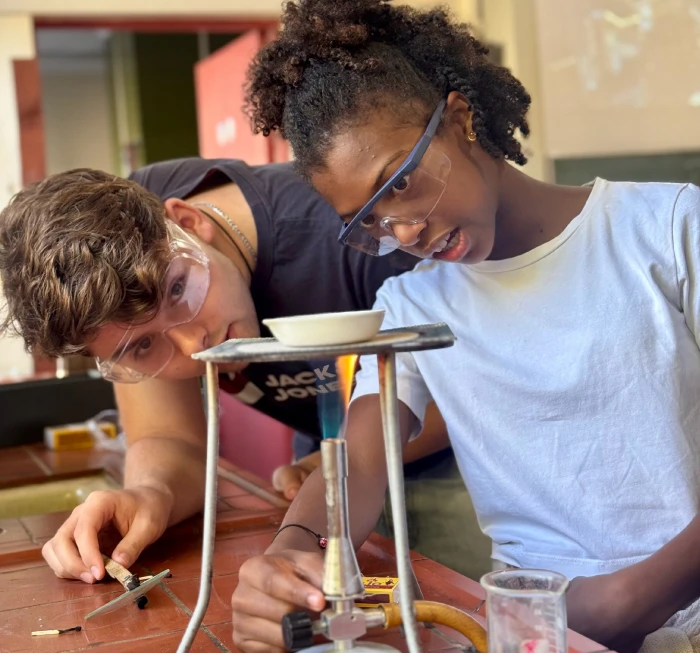
Vocational trial day for classes 5, 6, 8, 10
24.05.2013
Oral Abitur examinations
27.05.2013
2 p.m. U7 boys soccer game vs Porterhouse School at GSN
2.45 p.m. U13 boys basketball game vs Porterhouse School at GSN
6.30 p.m. School Board Meeting
28.05.2013
3 p.m. U9 boys soccer game at Porterhouse School
29.05.2013
6 p.m. General Meeting German School Society
30.05.2013
4 p.m. Graduation ceremony of the Abitur students, afterwards "Abifeier"
31.05.2013
No lessons
01.06.2013
Madaraka Day
03.06.2013
Class trips Cl. 4, 6, 11 until 07.06.
05.06.2013
Class trip Cl. 2 until 07.06.
Bilingual Kindergarten and Preschool

Our bilingual, international kindergarten is an all-day facility and takes children between 2 - 6 years of age into its Playgroup (mornings only), and Kindergarten. The newly opened buildings in September 2011 offer spaces for 104 children, who are split into 6 groups. Each group is led by a German and English-speaking teacher / assistant. Since the beginning of the academic year 2012/13, we at the Kindergarten are offering a DaF (German as a Foreign Language) group. In this group, instead of a second English speaking teacher, we have two German speaking teachers. This group will be attended by children whose first language is not German, so they can be further supported to learn the language. The Kindergarten is open on Mondays to Thursdays from 7.45 a.m. to 3.30 p.m. and on Fridays from 7.45 a.m. to 1.00 p.m.
The focal points of our pedagogical work are social upbringing, language instruction and nature as an environment to grow up in. Through differentiated and individual educational methods, we want to ensure that we support the development of each individual child.
As a German Kindergarten abroad, we have the great challenge of getting used to the different family situations of the children. The basis of our work is therefore to create a strong social environment, both for children who are growing up with two or three languages, as well as for German children, who are influenced by the (frequent) change of the city they can call home. In all our activities, we put particular emphasis on teaching social values, in the form of development of personalities and social education.
Children who are put into our responsibility need to grow up into their own "small" personalities, learn through play, without stress and worries. Nature as an environment to grow up in, either through daily experiences on the school compound, or outside through excursions is a fully integral part of life in the Kindergarten.

Social upbringing
Every child in the Kindergarten is considered uniquely. We try to deal with his / her needs and development stages individually. Every child is encouraged to gain experience and insight, to develop imagination, to learn skills as well as to nurture abilities, which will all help him / her to understand our world better, and to learn how to live within a community.
The children's "work" in the Kindergarten consists mainly of play. This is indeed the best way of understanding his / her environment. Through play, the child gathers positive and negative experiences, and learns how to deal with them.
Children learn various forms of acceptable behaviour through play, gain confidence and develop their personalities. During play, each child should be given the chance of enjoying whatever s/he wants to.
As part of the child's daily routine, we make a real effort to offer both free, as well as guided play, along with playing inside and outside.
Language instruction
Language instruction plays a very special role in an institution like ours. It is our main goal to equip as many children as possible with adequate German skills to be able to join us in Class 1 of the German School Nairobi. For this reason, we work in close conjunction with the Primary School.
Our Kindergarten groups are a mixture of children from only German-speaking homes, from only English -speaking homes, and of children who come from bilingual or even trilingual homes. Each group therefore has a German and English-speaking teacher / assistant, who speak to the children in her respective first language only. Since the beginning of the academic year 2012/13, we at the Kindergarten are offering a DaF (German as a Foreign Language) group. In this group, instead of a second English speaking teacher, we have two German speaking teachers. This group will be attended by children whose first language is not German, so they can be further supported to learn the language. Language development is especially promoted through stories, songs, circle exercises, music and movement, and simple finger games.
Through playing together with each other on a daily basis, children learn to express their wishes and feelings in both English and German. Children thus learn to communicate with one another in the two languages in an informal setting. This additionally helps to dispel fears of a new language and a new culture.
We work regularly in small groups, (which are separated using age and faculty of speech as criteria), to encourage each child individually. We keenly observe the children's development, and wherever necessary, bring any developmental setbacks to the parents' attention.
Nature as an environment to raise children
UNICEF (United Nations Children’s Fund) indicates that each child has the right to live and play in a stimulating and healthy environment. Nature activates a child’s development in every sense. Research shows, that children are very close to nature. We at the Kindergarten also consider nature as an important aspect of the development of our children.
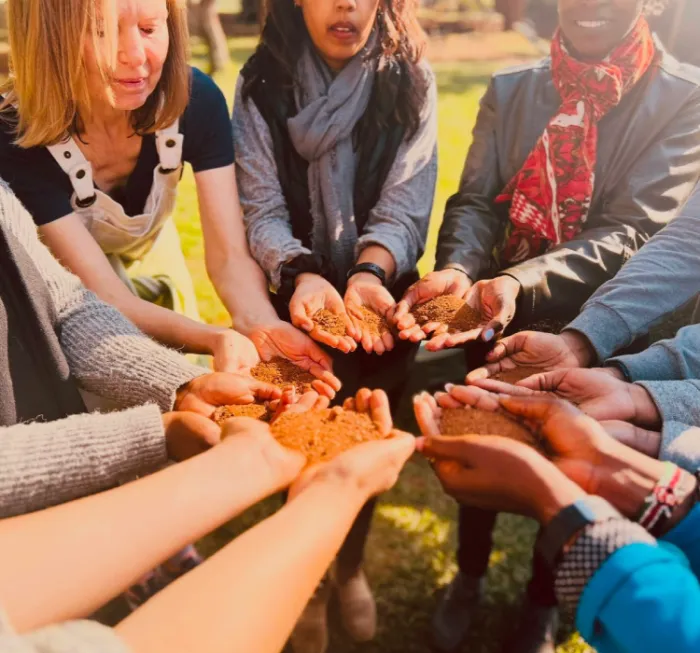
We go out in the nature on a daily basis with the children. Here, they learn about the flora and fauna around them, and are able to let their imagination run freely. At the same time, through movement, their locomotion skills are trained, and they become more balanced individuals, both mentally and physically.
Each week, one of the 6 groups visits the Nature Trail at the UN Recreation Centre. There we spend time looking at the birds and butterflies, getting to know various trees and plants, working with natural materials, and in short, becoming one with nature.

Daily Schedule
In our opinion, a "regulated", routine day is vital to a Kindergarten. While children should have the opportunity of free play, movement and to "be loud", they also need time to calm down and have some quiet time.
Our routine, with its rhythm, with its opportunities and rituals, gives the children a sense of direction and security. Rules and standards are very important to children, both when they are under supervised play, and when they are playing freely. In the latter situation, it is of utmost importance for the children to learn how to follow rules.
Weekly and Monthly Plans
Our projects are based on festivities over the year. Apart from that, we work on a project-orientated principle, i.e. we choose a topic for a project, which can be split into weekly units, and can be carried out for varied lengths of time.
Within our projects, we encompass all educational requirements for the holistic development of the child (linguistic, physical, social, musical, environmental, mathematical / logical components.)
Each group has a weekly timetable, made up of specific lessons, such as library lessons, P.E lessons in the Sports Hall, Music lessons in the Music Room, and Foreign Language German lessons.